
Apathy and Dopamine


Written by: Kristi Riker OTD, OTR/L
What is apathy?
Apathy is defined as, “a loss of motivation leading to a reduction in goal-directed behaviors” (Béreau, 2023).

Apathy, which often shows up in Parkinson's disease, isn’t just “feeling lazy” or even necessarily feeling sad. Apathy occurs when the brain’s motivation system gets dialed down. This causes a desire to act without internal push to do so. This is heavily tied to the brain’s dopamine pathways or "reward circuit.” Dopamine is largely responsible for anticipation and drive, so when these signals are disrupted, every day tasks may no longer feel worth initiating.
Those with apathy can still fully enjoy an activity once they are doing it. The barrier is starting - not the activity itself.
The Brain’s Reward Circuit:

The Mesolimbic Pathway is often described as the brain’s “motivation highway,” but it’s less about pleasure and more about deciding what’s worth your time and energy. The brain’s reward circuitry is one of the most important systems behind motivation, and it’s an area that often starts to go off track in Parkinson's
disease. At the center of this system is dopamine – the brain’s chemical messenger responsible for regulating movement, emotion, and reward. While motivation may seem solely dependent on enjoying an activity, it’s also affected by your brain determining if the activity will be rewarding enough. For example, you may not enjoy your job, but making money is a huge reward, so it is worth the effort for most people. Dopamine is about the reward, not just the enjoyment.
What changes in Parkinson’s
When PD causes dopamine-producing neurons to degenerate, the reward system can be heavily affected. Dopamine signals weaken and the “this is worth doing” signal becomes faint. This leads to “effort discounting”: when effort starts to feel disproportionately high compared to reward (McGuigan, 2019). When this happens, initiating a task can feel impossible – even if the individual wants to act. Simple activities such as calling a friend or engaging in a hobby stop feeling as though they’re worth the effort.
What can help?
An encouraging fact about the brain’s “motivation highway” is that it’s highly plastic or moldable. Repeated experiences can reshape what the brain recognizes as rewarding.
If you want to “rewire” the mesolimbic pathway in everyday life, the key isn’t big bursts of motivation—it’s repeated, well-timed experiences that teach your brain “this was worth doing.” Think of it as training the system that decides what deserves effort.
What helps when internal motivation is subdued? Researchers have found that external cues, such as routines, social support, or breaking up tasks can make up for lack of motivation (London, 2016).
Routines:
Routines can help by reducing the need for internal decision making. For example, if you go on a walk at 9AM every day, your internal dialog shifts from, “is this walk worth the effort” to “every day at 9AM, I go on a walk.” Behavior becomes more rule-based than value-based and you no longer need to decide, “is it worth it?”
Social expectations:
Social expectations can provide a healthy kind of pressure – accountability increases follow through because it leads to a cost for inaction. When you commit to a social activity, you don’t want to let others down. Social interaction can also increase the reward associated with an activity: connection, bonding, belonging. Structured group activities like Rock Steady are a POWERFUL way to provide external motivation.
Breaking tasks into tiny steps:
Breaking tasks up helps to lower the perceived effort cost. For example, instead of thinking about all the tasks involved in going on a walk, just think about putting your shoes on. This provides a simple and clear first action – remember, the hardest part is starting.
Stack wins early in the day:
Wins earlier in the day can shape how the brain predicts the rest of the day. Set yourself up with small successes - a simple physical task like stretching or showering. Complete a mental task like journaling or reading. Try checking tasks (even small ones) off a ‘To Do List’ – this can strengthen the dopamine reward response more than you may expect!

Intentional cueing:
Set up clear and consistent environmental cues and reminders to start a task. For example, ‘as soon as I walk into the kitchen in the morning, I empty the dishwasher.’ Set up visual cues, such as leaving the book you’re reading open on your nightstand. Associate activities – ‘as I brush my teeth, I do my mental exercises.’ Over time, the cues will start to trigger motivation as your reward system learns new patterns.
View ‘starting’ as success:
Reframe success to include starting an activity and give yourself permission to stop if needed. This trains the brain to perceive starting a task as manageable and not overly costly.
Add immediate rewards:
The brain learns best when rewards are close in time to the action. Include music, coffee, or a pleasant environment during/after tasks. Add a brief positive reflection: “That was worth it.”

Add novelty:
Novelty boosts dopamine—but it doesn’t have to be extreme. Rotate small changes: a new route for a walk, a different workspace, or a slight variation in routine.
Expect a delay – rewiring can take time! Early on, actions may feel flat and rewards may seem weak. With repetition, anticipation increases, tasks starting gets easier, and effort feels more worth it.
You’re not forcing motivation—you’re teaching your brain a new pattern of value: Small effort leads to consistent reward, which feels worth repeating. Done daily, this gradually shifts how the system evaluates effort, which is exactly what’s disrupted in apathy.
Why Does it Help to Understand Apathy?
(A note to care partners)
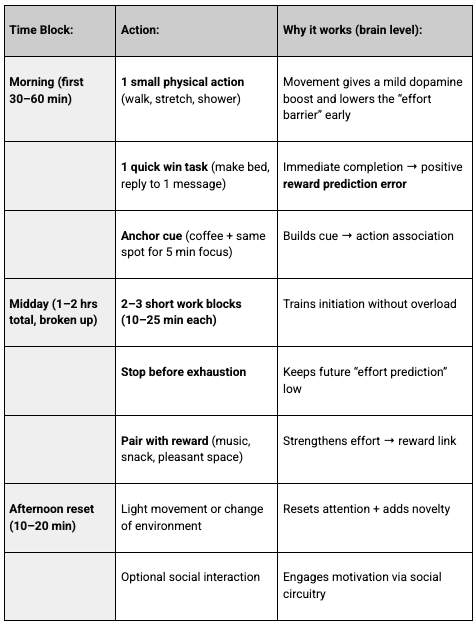
Apathy isn’t a personality issue—it’s a neurological one. And understanding that can completely change how people support someone dealing with it. When care partners can rationalize this, their internal dialog may shift from, “why aren’t you trying?” to, “how can we make starting easier?” One way to help your partner live with apathy is by supporting them with a daily plan, such as the one below.
Daily Plan to Reduce Apathy:

References:
Béreau, M.; Van Waes, V.; Servant, M.; Magnin, E.; Tatu, L.; Anheim, M. Apathy in Parkinson’s Disease: Clinical Patterns and Neurobiological Basis. Cells 2023, 12, 1599. https://doi.org/10.3390/cells12121599
London C. Butterfield, PhD,, Cynthia R. Cimino, PhD, […], and Michael S. Okun, MD, Volume 30, Issue 2016, https://doi.org/10.1177/0891988716673467
Sara McGuigan, Shou-Han Zhou, Méadhbh B Brosnan, Dominic Thyagarajan, Mark A Bellgrove, Trevor T-J Chong, Dopamine restores cognitive motivation in Parkinson’s disease, Brain, Volume 142, Issue 3, March 2019, Pages 719–732, https://doi.org/10.1093/brain/awy341
S.R.W. Stott, S.-L. Ang, Chapter 23 - The Generation of Midbrain Dopaminergic Neurons, Editor(s): John L.R. Rubenstein, Pasko Rakic, Patterning and Cell Type Specification in the Developing CNS and PNS, Academic Press, 2013, Pages 435-453, ISBN 9780123972651, https://doi.org/10.1016/B978-0-12-397265-1.00099-X.


Comments